Peptide Pureness & Return Optimizing In Spps Purepep Blog
Peptide And Peptoid Synthesis Core Poor-quality peptides (those with unnoticed impurities, incorrect sequences, or weakened components) can lead to deceptive data and irreproducible results. As a matter of fact, proteins and peptides are among one of the most widely made use of lab reagents, yet researches have shown that their top quality is usually inadequate, resulting in inadequate information reproducibility. Beginning with proper research laboratory recognition is for that reason a crucial part of a scientist's quality control operations. By insisting on peptides that come with verification of purity and identification, researchers can significantly minimize the threat of speculative artefacts. This contributes to the bigger reproducibility dilemma in science. Conversely, utilizing peptides that have actually passed third-party lab validation aids guarantee that the observed experimental impacts are absolutely because of the designated peptide and not due to pollutants or errors. It transforms an unlabeled white powder into a medically verifiable reagent. A modern HPLC system consists of numerous integrated components, each offering a specific function in the separation and discovery procedure. Separates and measures each element to validate outstanding pureness.
Framework Verification And Purity Evaluation
We combine LC-MS/MS and enzymatic food digestion analysis to exactly verify the series and adjustment websites of non-natural changed peptides. Peptides, with lengthy molecular series and diverse conformations, existing challenges for structure verification and content determination. BOC Sciences leverages high-resolution mass spectrometry, LC-MS/MS, and NMR to accurately assess molecular frameworks and offer extremely delicate quantitative support.
Material Warnings
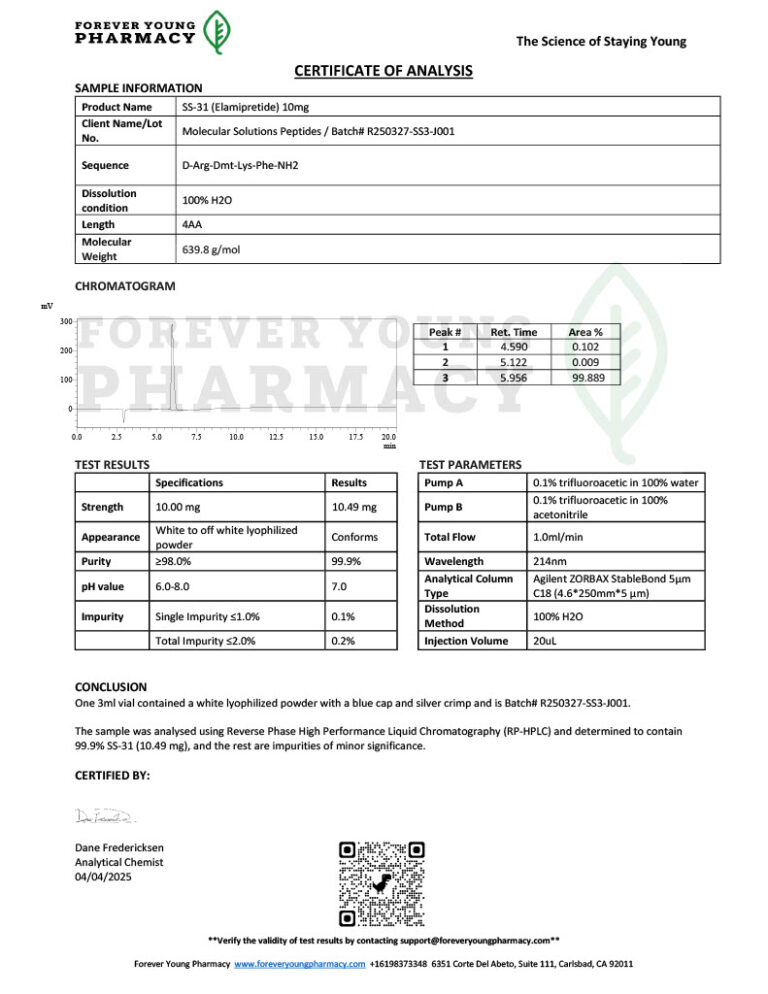
Peptide pureness testing stays one of one of the most crucial devices researchers utilize to evaluate study compound top quality.The table listed below demonstrate how purity specs put on a number of typically looked into peptide courses.Criterion turn-around is usually 5-7 company days from example invoice.
RUO COAs do not consist of endotoxin or sterility testing, although these are occasionally added by RUO suppliers. This Get more information is mostly safe as a lot of residue (TFA, residual dampness) is benign. Nonetheless, there is harmful non-peptide material, which must be screened for. The mobile stage, frequently a combination of water, acetonitrile, and an acid modifier, is kept in storage tanks and provided with the system by a high-pressure pump.
Is 95% pureness good for peptides?
Peptides with an 85% purity level or higher are usually made use of in enzyme assays or organic task researches. Peptides with purity above 95% are excellent for quantitative analysis.
The Limulus Amebocyte Lysate (LAL) examination is the typical method for endotoxin quantification. It utilizes a clotting reaction from horseshoe crab blood cells that is specifically caused by microbial LPS. Results are revealed in Endotoxin Devices per milligram (EU/mg) or per milliliter (EU/mL). Identification confirmation validates the specific secretagogue being studied. Peptides like BPC-157 and TB-500 used for injury recovery applications should get full verification. Identification verification is crucial because alternative with different compounds would fundamentally alter the research method. The testing procedure involves particular steps to make sure exact outcomes and appropriate example handling. For these high-stakes scenarios, the cost of testing is insignificant contrasted to prospective repercussions of making use of unproven products. For scientists complying with methods from resources like the BPC-157 and TB-500 piling guide, confirmed product high quality ensures the procedure obtains a reasonable examination. Underdosed substances create suboptimal outcomes that lead scientists to abandon effective procedures prematurely. Mislabeled peptides present variables that amaze research study outcomes. And counterfeit items, containing something completely different than claimed, produce unpredictable and potentially dangerous scenarios. Peptide pureness testing refers to logical treatments made use of to assess the structure of a peptide sample. Peptide pureness is essential for precise research and safe drug growth. Making use of high-purity peptides, validated by HPLC and MS, makes certain reputable results.
Quality Control For Scientists: Why It Begins With Validation
Importantly, purity percents explain chemical make-up only-- they do not show sterility or organic viability. Peptides from Maxed Out Substances are supplied specifically for research laboratory research study use and are not meant for human or vet purposes. The key point is not to confuse pureness (HPLC percent of the primary peptide vs pollutants) with general web content. For speculative planning (like computing molar focus), both pureness and web content serve numbers, however pureness is what shows the chemical homogeneity of the peptide sample. Acceptance limitations for research study use depend on the application-- cell-based assays call for stricter endotoxin limitations than, for example, binding assays using detoxified healthy proteins. HPLC can disclose new impurity optimals, boosted shoulder heights, or a reduced main-peak area after storage space or managing stress and anxiety. It is one reason proper peptide storage and reconstitution practices issue. Mass spectrometry verifies whether the measured mass matches the expected peptide mass. These approaches help recognize the peptide's make-up, verify the molecular weight, and discover any structural modifications or pollutants, guaranteeing the peptide fulfills quality and specification needs. MS confirms the correct Homepage molecular weight and is highly conscious mass distinctions representing amino acid substitutions, removals, or adjustments. For the verification of standard study peptides from developed distributors, ESI-MS offering the right molecular weight is considered enough verification of identification. Peptide pureness is verified mostly with reverse-phase HPLC, which divides the target substance from pollutants and quantifies their loved one height areas. A stated pureness of ≥ 98% implies at least 98% of the UV-absorbing product eluting from the column corresponds to the target peptide. Endotoxin LAL testing and Certification of Analysis testimonial finish the confirmation picture for research-grade product.